
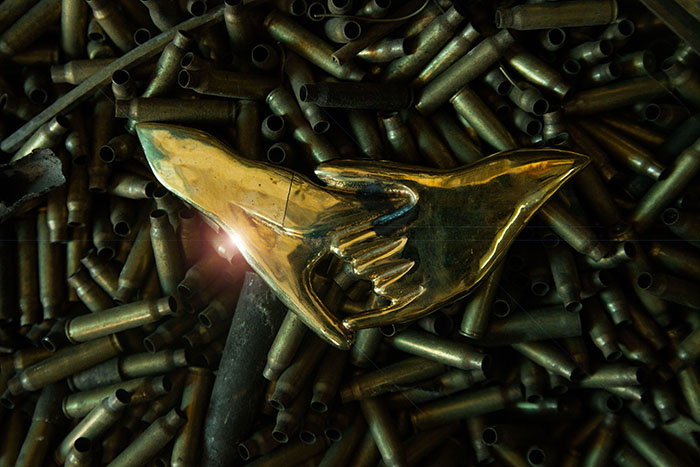
Not all waste is equal. A discarded plastic bottle is bad. Exploded remnants of war is something else entirely.
War debris carries collective grief and destruction with it. Fashion, meanwhile, is built on desire and the absence of difficulty. That’s the tension at the core of what I did for ten years: I ran a business that turned war debris from Cambodia into jewellery, sold through boutiques.
Normally rarity makes something valuable, and a bad association makes something cheap. War debris breaks that rule. It’s rare in the way that should create value, and stigmatised in the way that should destroy it. It sits in both categories at once.
Running that business, I hit two real compromises. The first was structural. Sourcing conflict-derived material is opaque by nature, you can’t fully trace a casing back through a war zone the way ethical fashion supply chains want you to trace a cotton shirt. That opacity never went away.
The second was about story, not supply chain. Over time, the narrative kept sliding toward the artisans, their poverty, their circumstances. It became a poverty alleviation story. That wasn’t the point, and it quietly undercut the harder claim I was actually making: that this material could carry aesthetic and symbolic weight, not just charitable weight.
But neither of those compromises touches the thing that actually happened underneath them: the transfer. Sold through 55 retailers over ten years, seen by buyers, press, stockists, the value transformation was real and visible. Debris became object. Violence became craft.
That’s the proof, for me, that upcycling done at a radical level, not the polite kind, can hold craft, aesthetic, symbol, and ethics all at once. Conventional upcycling doesn’t get near that.


