
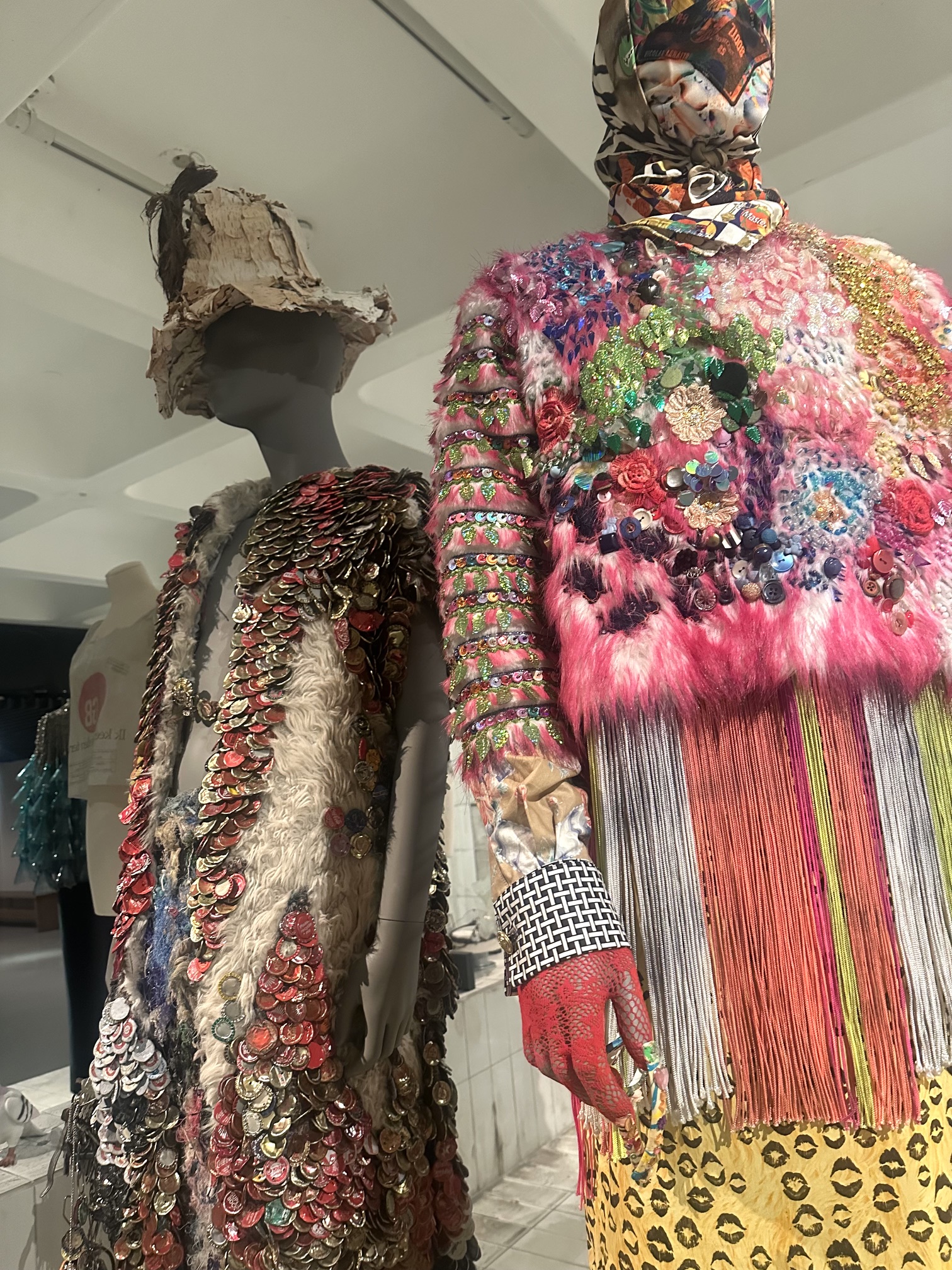
Dirty Looks: Desire and Decay in Fashion (25 September 2025~25 January 2026), the Barbican’s first major fashion exhibition in eight years, gathered fifty years of designers who used dirt, decay, and difficult materials to push back against fashion’s obsession with glossy surfaces. Walking upstairs through the show, the development is visible: waste and imperfection is seen as material to draw attention to itself, then something more considered.
To me, the works by Martin Margiela and Hussein Chalayan were the most beautiful, in their sophisticated thought process using imperfection as ultimate finish. Margiela offers the unfinished garment as its own form of beauty: seams exposed, edges raw, the making left visible rather than concealed. Hussein Chalayan goes further. He buried newly made dresses in earth and let time and soil do the finishing. The garment ages before it is ever worn, decay used deliberately as a design process rather than something fashion tries to outrun. Both designers are making the same underlying claim from different directions: that fashion does not have to be perfect to be beautiful, and that deliberate imperfection can be its own aesthetic statement.
What makes all of these items beautiful though? How can stigmatized materials that remind us of waste, dirt and even violence become desirable? Perhaps that lies in how it is framed for the viewer.
Fashion is always mediated. It is always presented in some way. Someone designed it. Someone markets it. Someone wears it. There are decision making processes everywhere. The meticulously curated environment of the gallery is allowing Chalayan’s earth-aged dress to be read as artwork rather than as something merely spoiled. McQueen’s torn lace, Westwood’s punk-era earth politics, the show frames all of it within a fifty-year lineage of designers using difficulty on purpose. Dirty looks can become desirable when presented as such by the maker, the wearer or the environment it is seen in.
As I moved towards the exit, lost in thought, I stopped short at the gallery shop. It struck me as ironic that decay and difficulty were deliberately repackaged here as something shiny and new, purchasable, as souvenirs, as something shiny and new, purchasable, as souvenirs. It was like a mirror held up to a mirror, seen through a frame. The exhibition asks the visitor to sit with discomfort. The shop asks the visitor to take a version of that discomfort home, smoothed into something that will not actually make anyone uncomfortable at all. Dirt, as it turns out, is harder to gift wrap than it looks.
Emi & Eve has run the same mechanism commercially, at higher stakes, for a decade, with material that’s more viscerally difficult than soil. We take the dirtiest kind of waste, exploded ammunitions debris, and turn it into clean luxury jewellery. We offer hope through this transformation process, and the end products act as symbolic reminder of the wearer’s own story of overcoming.
Like the exhibition, we show that waste can have agency. It is possible to redeem even the most stigmatized trash. Throughout the ten years running Emi & Eve, the value transformation occurred and was visible to buyers, press and retailers, evident in press and customer feedback, demonstrating that upcycling practiced at a radical level can produce wearable fashion carrying a layered density of meaning: symbolic, aesthetic, craft and personal affect.


Feature image: Ayumi Kajiwara (left) and Manon Kundry (right)